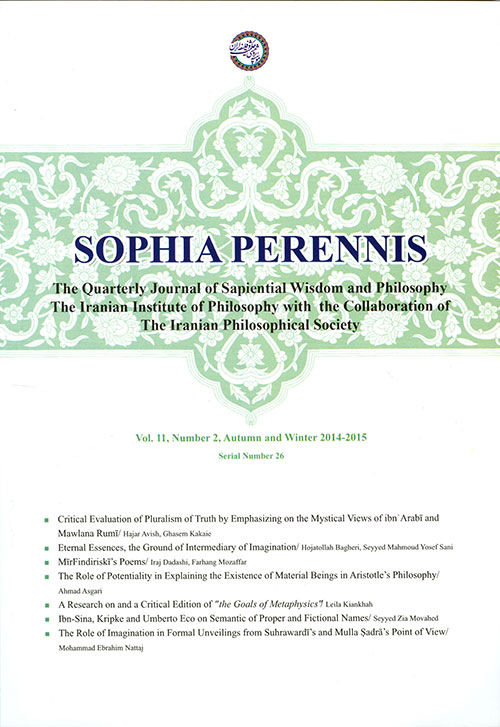
The Role of Potentiality in Explaining the Existence of Material Beings in Aristotle’s Philosophy
Keywords:
being, Substance, Substratum, Essence, form, ActualityAbstract
Aristotle's project in Metaphysics is to investigate being, qua being. He searches the principles and the causes of beings as such. He intends to explain why the beings exist, and what does existence for each being. Both essence and substratum can provide a basis for explaining the existence in different way. The problem Aristotle has faced here is that on the one hand the combination of essence and substratum is real at least in material substances, on the other hand substance which is basis for existence is supposed to be unitary and prior. In analyzing and answering to this problem Aristotle uses potentiality. The thing which exists, i.e. substratum and the thing that a being comes into existence by it, i.e. essence are not disparate, rather they are two modes of one thing: mode of being potential and actual. Thus, although the combination (of matter and form) is real, it does not contradict with the unity of substance, since one is the actuality of the other. What provides us with the response to explain the existence of the material substances is "potentiality".Downloads
Publication Timeline
Published
Issue
Section
مقالات
How to Cite
Asgari, A. (2022). The Role of Potentiality in Explaining the Existence of
Material Beings in Aristotle’s Philosophy. Sophia Perennis (Jāvīdān Khirad) , 11(26), 83-118. https://www.journalsirip.com/index.php/javidankherad/article/view/753